

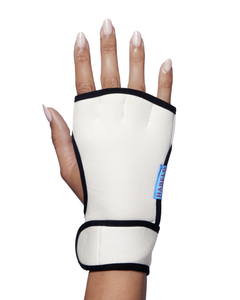



Hands, Explained is a series exploring the science behind aging hands and what it actually takes to care for them effectively. Hands age faster than the face, yet they’re often overlooked in skincare. Here, we break down the biology and evidence—clearly, calmly, and without hype.
Most of us approach aging through a familiar lens: the face. Serums, treatments, SPF, professional care—all carefully chosen and applied. And yet, for many people, the first visible signs of aging don’t appear on the face at all. They appear on the hands.
This isn’t a matter of neglect or bad habits. It’s biology.
Hands age faster than the face because they are structurally different, constantly exposed, and far less protected. Understanding why changes how—and how seriously—we care for them.
At a fundamental level, the skin on the hands is not the same as the skin on the face. Hands have thinner skin, particularly on the backs of the hands, and significantly less subcutaneous fat. They also have fewer sebaceous, or oil-producing, glands, which means lower natural hydration and a weaker lipid barrier. Facial skin benefits from greater oil production and a thicker support structure. Hand skin does not. As a result, it has less natural resilience and fewer built-in defenses against aging.
Beyond biology, hands experience constant environmental exposure. While facial skin is often protected by skincare routines, makeup, and daily SPF, hands are exposed almost continuously. They encounter ultraviolet radiation every day, frequent handwashing and sanitizing that strip natural lipids, temperature extremes, and ongoing mechanical stress from repeated movement and friction. Over time, this cumulative exposure accelerates visible aging. UV damage in particular breaks down collagen and elastin, contributing to pigmentation, thinning skin, and loss of elasticity. Unlike the face, hands rarely get a recovery window.
Collagen loss is a natural part of aging, but its effects are not evenly distributed across the body. Because hand skin is thinner and contains less fat, structural changes become visible sooner. As collagen and elastin decline, skin loses firmness, veins and tendons become more pronounced, and texture appears thinner or crepey. These changes are gradual and cumulative, but once advanced, they are difficult to reverse. What makes hands unique is how quickly underlying biological shifts translate to visible signs of aging.
For decades, hand care has been treated primarily as a hydration problem. Most traditional hand creams are designed to soften the skin, relieve dryness, and improve comfort temporarily. Hydration is important, but it is not the same as treatment. While hand creams can support the surface of the skin, they are generally not formulated to address structural aging, support collagen pathways, or improve long-term skin quality. This is why hands can feel moisturized yet still look aged. Hydration alone does not address thinning skin, loss of elasticity, or visible volume changes.
Because hands age differently, they require a different approach. Effective care for aging hands focuses on supporting the skin barrier, using targeted ingredients appropriate for thin, sensitive skin, and applying treatments consistently rather than occasionally. It requires formulations designed for performance, not just comfort. Treating hands like an afterthought—or treating them like facial skin by default—overlooks their unique biology.
Hands age faster than the face for clear, biological reasons. They are thinner, less protected, constantly exposed, and structurally vulnerable to early collagen loss. Once you understand this, the solution becomes clearer: hands deserve care that is as intentional and evidence-led as facial skincare, designed specifically for the skin that shows age first.
This article is part of Hands, Explained, a series exploring the science behind aging hands and what it actually takes to care for them effectively.